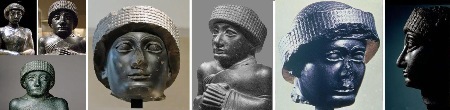
His origins are obscure. It's believed he wasn't a native of the city of Lagash. He became a member of the ruling family of Lagash by marrying Ninalla, the daughter of the king, Ur-Bau. It is perhaps significant that he never signed himself as dumu, "son of..." This suggests that his father was only a minor nobleman and not a ranking member of the high nobility.
Gudea reigned from 2140 - 2120 B.C., during a time of political instability for the Sumerians. The Akkadian Empire, which had ruled Sumer for almost 200 years, had been overrun by the Gutians, nomadic tribesman from the north. Although the Sumerians were no longer answerable to their Akkadian overlords, they were now in jeopardy from the Gutians, who were starting to encroach on Sumerian territory. One of Gudea's concerns was guarding against the frequent border raids of the Gutians, who would eventually take over the neighboring city-state of Uruk. Gudea spent much of his time building temples and city walls, and restoring those which had been destroyed in the constant warfare endemic to the region. He lived in difficult and dangerous times.
Gudea was sipa zid, "the true shepherd." He was the model of piety and virtue, working tirelessly for the gods and the welfare of his people. He was concerned about social justice, and not just the exercise of power. Gudea was as much a priest as a king. He spoke with the gods in his dreams. In this way he was told to build the great temple of Ningirsu. Gudea valued wisdom and learning, and the arts flourished during his reign. Gudea loved peace, but he was also a pragmatic realist who could guide his people through perilous times. He was truly a great leader, one of the first in world history.
He is wise, and able to realize things. The ruler gave instructions to his city as to one man. The land of Lagash became of one accord for him, like children of one mother. He opened manacles, removed fetters; established ……, rejected legal complaints, and locked up (?) those guilty of capital offences (instead of executing them).
He undid the tongue of the goad and the whip, replacing them with wool from lamb-bearing sheep. No mother shouted at her child. No child answered its mother back. No slave who …… was hit on the head by his master, no misbehaving slave girl was slapped on the face by her mistress. ... The ruler cleansed the city, he let purifying fire loose over it. He expelled the persons ritually unclean …… from the city.
He had everything function as it should in his city. Gudea had built the E-ninnu, made its powers perfect. He brought butter and cream into its dairy and provided its …… with bread. He had debts remitted and made all hands clear. When his master entered the house, for seven days the slave woman was allowed to became equal to her mistress and the slave was allowed to walk side by side with his master. But the ritually unclean ones could sleep only at the border of his city. He silenced the evil-speaking tongue and locked up evil.
He paid attention to the justice of Nanshe and Ningirsu. He provided protection for the orphan against the rich, and provided protection for the widow against the powerful. He had the daughter become the heir in the families without a son. A day of justice dawned for him. He set his foot on the neck of evil ones and malcontents.
The Sumerian kings were the first monarchs in history who were concerned about the welfare of their subjects. You never hear about Egyptian pharaohs or Chinese emperors being solicitous about the welfare of the common people. See The Shepherd Kings.
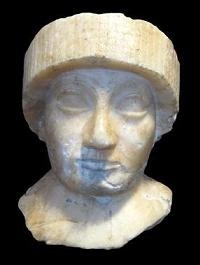
Gudea: His crown is a stylized shepherd's hat.
Most Sumerian statues have been decapitated, had their faces disfigured, or were otherwise vandalized during the many wars that occurred in the region.
The seal of Gudea: Gudea, with shaven head, is accompanied by a minor female deity (lamma, guardian spirit). He is led by his personal god, Ningishzida, into the presence of Enlil, the chief Sumerian god. Wind pours forth from of the jars held by Enlil, signifying that he is the god of the winds that bring life giving rains. The winged leopard (dragon?) is a mythological creature associated with Ningishzida, The horned helmets, worn even by the animals, indicates divine status (the more horns the higher the rank). The writing in the background translates as: "Gudea, Ensi [ruler], of Lagash."
Although Gudea used the title ensi (ruler, governor) rather than the more exalted title of lugal (king), he was a king in all but name. Unlike other Sumerian kings, however, did he not use the sign diĝir in his name (meaning a "god" or "deity") which designated divinity. Gudea did not represent himself to be a god, but only as a man who was divinely favored, so it's significant that Gudea is shown bareheaded, without his crown, and with his hands raised in the "reverence position," as was required of a mortal man when in the presence of a god. A king like Ur-Namma was shown standing before the god Enlil with his hat on, signifying that he too is a god (see Ur-Namma Translation).
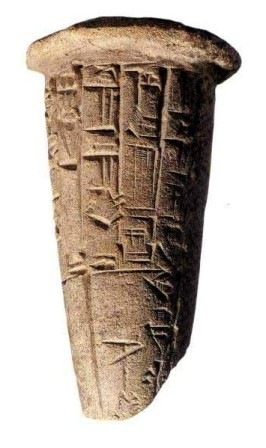
Gudea foundation cone.
Clay cones (nails, pegs) were inscribed with dedications and driven into the foundations of a temple. This cone is from the temple of Ningirsu, the god of war and the patron diety of Lagash. The building of this massive temple complex was the central event of Gudea's reign. In The Building of Ningirsu's Temple (the E-Ninnu), Gudea recounts the vast amount of labor and the many exotic materials from distant lands that were used in its construction. It may seem like a contradiction that Gudea, who usually portrayed himself as a man of peace, was building a temple to the god of war. Unlike other ancient kings, Gudea did not routinely boast of his military prowess. He was not the kind of king, like Naram-Sin or Eannatum, who would portray himself marching to victory over the bodies of his enemies. Surviving records show that he led only one minor military campaign. There is no mention of the exotic materials from faraway lands being brought in as tribute from conquered people; rather the materials seem to have been obtained through trade and commerce. More than any other Sumerian king, Gudea emphasized his role as "shepherd," rather than "conqueror." So why did he put so much effort and so many resources into building a temple to the god of war?
The answer to this question is best seen in the map below:
The Gutians (north, yellow) had already taken over Akkad (west) and during the reign of Gudea's son, Ur-Ningirsu, they had reached as far south as the Sumerian city of Uruk, which they destroyed. But the Gutians never conquered Lagash (red) even though they had it virtually surrounded. It seems the Gutians went out of their way to avoid attacking Lagash. This is because Gudea made Lagash militarily strong enough to preempt any Gutian attack. Thus he was able to provide his people with twenty years of peace and prosperity while also insuring their safety, like any good shepherd would do. Although Gudea is usually portrayed as a gentle, pacifist priest-king, he was also a tough-minded realist. He knew the time was not yet ripe for a full scale Sumerian rebellion because the Gutians were still too strong and the Sumerians were still too weak and divided. This is why building a temple for the war god was so important.
For Gudea, building and restoring the temple of the war god symbolized the re-emerging hopes of Sumerian independence, after two centuries of Akkadian domination and during the ever present danger of attack by the Gutian barbarians. The battle for Sumerian independence would not occur until after death of Gudea, at the time of Utu-Hengal and Ur-Namma. In the meantime, rebuilding the temple fostered Sumerian cultural identity and promoted a strong "national" spirit. In rebuilding the temple, Gudea was rebuilding the Sumerian nation, thus leading the way for Ur-Namma and the Neo-Sumerian Revival.
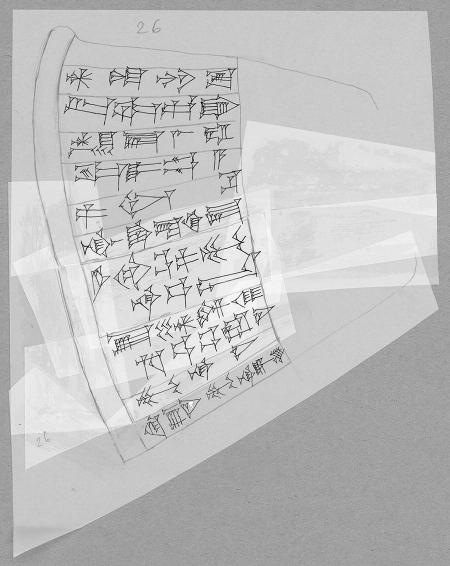
Translation of a Gudea foundation cone:
Line drawing of a Gudea foundation cone, by Marcel Sigrist. Gudea's name (gu3-de2-a) is on the 4th line down, reading left to right. Enlarge.
Note: {d} designates diĝir and is not pronounced. The numerical subscripts of the signs are also unpronounced.
Transliteration:
1. {d} nin-ĝir2-su
2. ur-saĝ kal-ga
3. {d} en-lil2-la2-ra
4. gu3-de2-a
5. ensi2
6. lagaš-ki-ke4
7. niĝ2-ul-e pa mu-na-e3
8. e2-ninnu {d} anzud-{mušen}-babbar2-ra-ni
9. mu-na-du3
10. ki-bi mu-na-gi4
In line 7, niĝ2-ul could be translated as niĝ2-du7, meaning "something suitable or appropriate."
Translation:
For Ningirsu
Mighty warrior of Enlil
Gudea
The ruler of Lagash
Brought forth something everlasting
The Temple Ninnu, of Anzud the White Eagle
He built
This place he restored
Note: Ninnu means "fifty," denoting 50 divine powers.
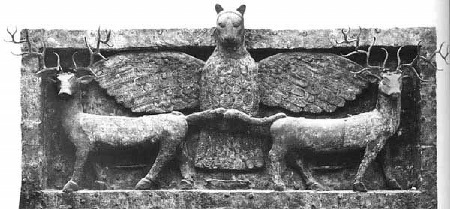
Anzud: with two stags.
Anzud was the lion-headed eagle, the god of storms. He was a mythological creature closely associated with Enlil and his son, Ningirsu. Anzud had a dual personality, sometimes benevolent, and sometimes malevolent. Anzud stole the Tablet of Destiny, where man's fate is decreed. Under the command of Enlil, the gods tried to recover the tablet. During the ensuing struggle, Anzud "the white eagle" was killed by the warrior Ningirsu. Anzud thus became the symbolic animal of Ningirsu. This is why Anzud's name was associated with the temple of Ningirsu, as seen in the inscription above.
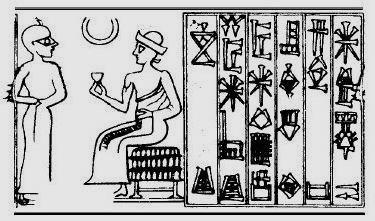
The god Gudea.
This is a cylinder seal impression of Ur-Sharura, a functionary in the temple of Gudea. It is dated in the Ur III period, after the death of Gudea, when he was worshiped as a god. The sign diĝir appears before his name in the upper right corner, indicating divinity. The sign was not used with Gudea's name during his lifetime. He was worshiped as a god only after his death.


































































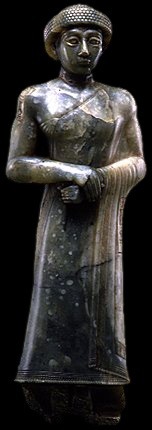
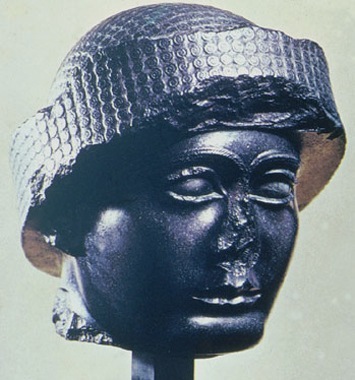 Gudea: His crown is a stylized shepherd's hat.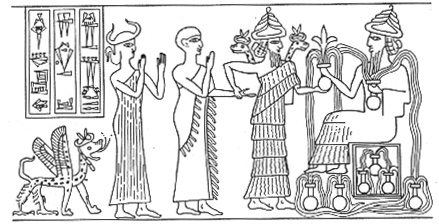
 Gudea foundation cone.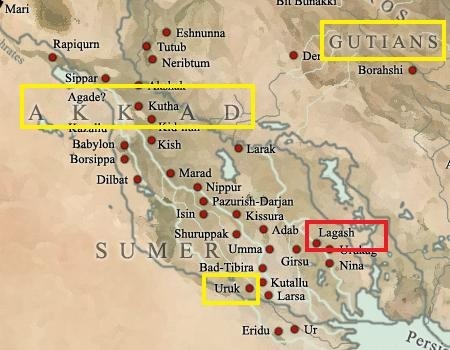
 The god Gudea.